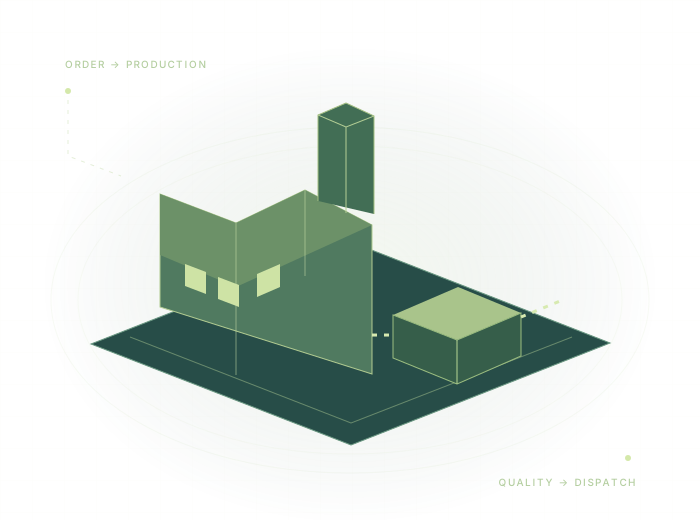
Spot shortages before a job starts
Bring the information together so it is easier to find and act on.
ENGINEERING / FABRICATION / ASSEMBLY
Manufacturing operations
From the customer promise
to the finished product.
Make the work visible.
Connect orders, materials, production, quality and maintenance in one company workspace. Give your office and shop-floor teams a clearer view of what needs to happen next.
Explore your AI Copilot View Manufacturing Operations plans from ₹1,499/monthTry free for 15 daysYour company workspace. Your team’s own AURTIV login.

Plan production around the stock, capacity and customer commitments you actually have.
Keep the starting record, its owner and its next action together. Your team can work from the same context.
One view of the stages your team manages.
Illustrative records by stage. This is an example, not live customer data or a performance claim.
Bring the information together so it is easier to find and act on.
Use structured stages, ownership and review points to keep work moving.
Use the records you already capture to plan your next action.
WHAT A MORE CONNECTED DAY CAN LOOK LIKE
A focused workspace helps your team refer to the same records and understand the next step. Here is where the product can make a practical difference.
Connect the customer order to production progress and finished-stock dispatch.
Review receipts, issues and production consumption in a recorded movement history.
Optional quality and maintenance modules keep holds and due work in view.
HOW THE WORK CONNECTS
Follow a typical journey through the product. Each stage gives the next person useful context instead of another disconnected update.
Record the customer, finished item, quantity and committed date.
Define the single-level BOM and review component stock.
Track production and record the required quality inspection.
Post finished stock, then dispatch available quantities against the customer order.
EXPLORE THE FEATURES
Select a feature to explore what your team can do, why it matters and an everyday example. Optional modules are agreed as part of your subscription.
Record the customer, finished product, quantity and due date, then connect the order to production. Dispatch uses available finished stock.
Your team can review the promise and the work behind it together instead of searching separate records.
A fabrication team records an order for 20 brackets, sets the committed date and links the production job.
Maintain raw materials, consumables and finished items. Record receipts and issues and review the movement ledger. Reorder thresholds give stock levels context.
Stock changes have a recorded reason, making it easier to investigate shortages and prepare the next job.
A storekeeper receives steel stock and later reviews the component issues linked to completed production.
Create a single-level BOM with component quantities per finished unit. Revisions let the recipe change while existing production orders keep their saved BOM snapshot.
Older jobs remain understandable even after the product recipe changes.
A new BOM revision changes the fastener quantity for future jobs; the job already issued keeps its original component list.
Create production orders with quantities and due dates, start the work, then complete the full order. Completion consumes components and adds finished stock together.
The production update and its stock effect stay connected, reducing separate manual updates.
An operator completes the planned assembly job; required components leave stock and the finished quantity is added.
Record checked, accepted and rejected quantities with pass, hold or fail outcomes. When quality is enabled, completion requires a passing inspection covering the full order.
A quality hold becomes visible in the system and can prevent a job moving forward too early.
A batch is held after inspection. The team records a passing full-quantity check before completing it.
Register equipment and assign preventive or corrective tasks with owners, dates and status. Record downtime and review what is due.
Maintenance tasks have an owner and a record rather than depending on a reminder in a conversation.
A workshop schedules a machine service, assigns a responsible person and records the task’s completion and downtime.
Review explainable rules for low stock, overdue production, quality holds and due maintenance. Alerts use the operational records your team saves.
Managers get a focused starting point for review instead of checking every register individually.
The daily review surfaces a material below its threshold and a production order past its due date.
Examples are illustrative. Feature availability follows the enabled modules and permissions in your company workspace.
ILLUSTRATIVE BUSINESS WALKTHROUGH
Imagine a small assembly business making 20 units for a customer. This example shows how the records connect.
Map your own workflow with AURTIV ↗︎Office records the customer order and commitment.
↓Stores reviews components against the saved BOM.
↓Production completes the job after the required check.
↓Finished goods become available for the order’s dispatch.
FROM SCATTERED WORK TO SHARED CONTEXT
The aim is to make information and ownership easier to follow. These examples compare a common way of working with the supported product workflow.
Orders spread across sheets and messages
A customer order with quantity, commitment date and linked production.
Material balances updated separately
Stock movements recorded as receipts, issues, production and dispatch happen.
Quality checks discussed without a shared record
Recorded inspection quantities and a quality gate when the module is enabled.
ACCESS THAT FITS THE WORK
Your team signs in with its own AURTIV accounts. Product records are scoped to the company, and roles determine which workflows each person can use.
Manage the company workspace, team access and operations.
Configure items, BOMs, orders and equipment; review activity.
Record stock movements, production progress, inspections and maintenance updates.
Read company operations without changing records.
AURTIV AI Copilot · Included in your workspace
In your signed-in manufacturing workspace, AURTIV AI answers supported operational questions using your company's saved dashboard totals. It is read-only, restricted to the information your staff role is allowed to access, and cannot access another company's records.
Check recorded open work orders, not an invented production forecast.
See how many inventory items have fallen below the recorded threshold.
Review the count of production orders marked overdue.
Privacy by design: Operational summaries only. Do not enter employee names, personal contact details or confidential individual records. No unrestricted record searches, payment actions, or automatic changes. Browser voice recognition may use Cloudflare speech processing.
Sign in to try AURTIV AICORPORATE SUITE · INDUSTRY BUSINESS STACK
Start with your industry workspace and add the business applications your team needs. HR appears once. App permissions and workspace limits remain explicit.
Explore individual features and component prices
PROMOTIONAL SUITE PRICES
Published Suite prices are discounted from component list prices. Annual billing adds 20% savings against the Suite monthly price, with 12 months paid upfront.
4 included products · Launch tier in each app
₹2,999 billed monthly
Component list total ₹3,796/mo · Suite saving 21%
Annual: ₹2,399/mo equivalent · ₹28,788 upfront
Per company workspace, + applicable GST. Core staff allowance: 3. Each app’s allowance is shown above; seats are not added or pooled. Custom usage and onboarding are quoted separately.
Request Essentials bundle ↗︎Compare bundle ↗︎5 included products · Growth tier in each app
₹7,199 billed monthly
Component list total ₹9,595/mo · Suite saving 25%
Annual: ₹5,759/mo equivalent · ₹69,108 upfront
Per company workspace, + applicable GST. Core staff allowance: 8. Each app’s allowance is shown above; seats are not added or pooled. Custom usage and onboarding are quoted separately.
Request Growth bundle ↗︎Compare bundle ↗︎6 included products · Operations tier in each app
₹14,299 billed monthly
Component list total ₹20,494/mo · Suite saving 30.2%
Annual: ₹11,439/mo equivalent · ₹1,37,268 upfront
Per company workspace, + applicable GST. Core staff allowance: 20. Each app’s allowance is shown above; seats are not added or pooled. Custom usage and onboarding are quoted separately.
Request Complete bundle ↗︎Compare bundle ↗︎INR list prices effective 3 November 2026, excluding GST. Annual billing is paid upfront. Suite discount targets are 20% / 25% / 30%; exact savings vary with rounded published prices. No automatic charge, external messaging or unlimited AI. Access depends on app permissions; supported cross-app links are configured explicitly.
The tools behind Manufacturing Operations, grouped around the work they help you do. Availability depends on your plan, enabled modules and role.
Choose the capabilities your team needs during onboarding. Payment records do not verify online payments. External messaging, device connections and regulated or certified compliance workflows require a separately agreed scope.
TRANSPARENT SOFTWARE SUBSCRIPTIONS
Production, stock and order workflows. Monthly and annual options, with a dedicated company workspace.
Annual billing saves approximately 20%.
Explore core Manufacturing Operations workflows with up to 3 team accounts. No credit card, no automatic charge. Verify your email to start a private 15-day trial (UTC calendar days, start date included). Access ends when the trial expires unless you agree to a paid plan.
Up to 3 staff accounts
Annual: ₹1,199/mo equivalent · ₹14,388 paid yearly · Save ₹3,600/year
Discuss Launch planUp to 8 staff accounts
Annual: ₹2,399/mo equivalent · ₹28,788 paid yearly · Save ₹7,200/year
Discuss Growth planUp to 20 staff accounts
Annual: ₹4,799/mo equivalent · ₹57,588 paid yearly · Save ₹14,400/year
Discuss Operations planIndicative launch prices in INR, excluding applicable GST. Annual plans are paid upfront. One company workspace per subscription. Module entitlements and team limits are agreed at provisioning; onboarding, migration, additional users and custom work are quoted separately. No self-service checkout or automatic billing.
START WITH YOUR REAL WORKFLOW
We agree the product fit, enabled modules, user allowance and onboarding scope before rollout. Start with a small group and a workflow you can review.
Walk through your process with AURTIV. Confirm that the product’s current capabilities fit the workflow and agree what a useful pilot should show.
AURTIV provisions the company and administrator account. Prepare the relevant directories and opening records, then activate the team’s accounts.
Work through representative scenarios, review permissions and help the team adopt the process. Agree any continuing support or separately scoped improvements.
CLEAR FROM THE START
Know the product’s current scope before deciding how it fits your business.
Product privacy notice ↗︎It is a focused manufacturing operations workspace. Use it for the documented order, inventory, production and optional quality/maintenance workflows. Wider ERP and planning needs require separate assessment.
No. Current manufacturing alerts use explicit rules such as reorder thresholds and overdue dates. Custom AI work can be explored as a separately scoped service.
Yes. Record partial production receipts and split dispatches, subject to stock availability, quality checks and your enabled modules.
AURTIV provisions your company workspace and administrator account. Users receive private activation links, choose their passwords and sign in directly to the product. They do not need a separate external CRM or AI account.
We agree product modules, user allowance, access term and any onboarding or support services before purchase. Start with a conversation about your workflow and pilot needs; no price or performance guarantee is assumed.
Current workflows include purchasing, capacity scheduling, partial production and dispatch, material allocation, warehouse transfers, batch/serial traceability, costing and reviewed Suite links. Machine telemetry, certified tax filing and predictive-maintenance guarantees require a separate scope.
YOUR NEXT STEP / AURTIV MANUFACTURING
Tell us what your team does today, where information gets lost and what you want to improve. We’ll help you review the product and define a useful starting point.
Inside Manufacturing Operations
Plan production around the stock, capacity and customer commitments you actually have. Explore the operating flow, application architecture and access controls behind the workspace.
Relevant capability area: Procurement. Purchase management: Purchase requests, RFQs, POs, receipts and supplier returns. Supplier management: Supplier terms, quotations and performance.
Relevant capability area: Factory operations. Production scheduling: Work-centre and shift capacity. Shop-floor management: Operator progress and machine logs.
Relevant capability area: Inventory & traceability. Multi-warehouse management: Plants, warehouses, bins, transfers and reconciliation. Batch and serial tracking: FIFO/FEFO batches, serials and genealogy.
The browser workspace presents the enabled Manufacturing Operations modules. Requests go to application APIs on Cloudflare Workers, where the signed-in account, company scope and product permissions are checked. Structured business records are stored in D1; supported private file workflows use R2. A shared platform does not mean shared access to another company’s records.
Subscription, role and module access determine which functions a user can use. Linked Corporate Suite applications require the relevant access and supported integration; they are not automatically included in every product plan.
Protected API routes apply company and role checks on the server. Session cookies use HttpOnly and SameSite restrictions, with the Secure flag on HTTPS. Write operations use origin and CSRF checks, and API responses use no-store cache controls. Administrators should assign only the access each person needs and remove accounts when access is no longer required.
These are implemented application controls, not a guarantee of security or a compliance certification. Your deployment configuration, data handling, staff practices and recovery requirements also need review.
Use the product’s permitted reports and supported read-only Business Agent questions to understand company records. Available sources depend on your role and enabled features. AI outputs should be checked against the underlying records, especially before financial, legal, health or other consequential decisions.
A model’s explanation does not itself authorise a business change. Product actions and approvals remain in their supported workflows. Confirm AI processing requirements before entering sensitive information, and keep public demonstration workspaces limited to fictional data.
Walk through your actual customer demand to dispatch & cost review process. Confirm the modules, roles, import requirements, data retention, supported integrations and support coverage. Test representative scenarios in a suitable workspace and agree who owns onboarding and ongoing administration.
Expected benefits depend on the quality of your records and adoption by your team. Use the existing product scope and pricing details on this page to agree the fit; specialist regulatory, accounting or clinical requirements need separate assessment.